
6 Steps for Screening Vendor Bending Strain Results from In-Line Inspections
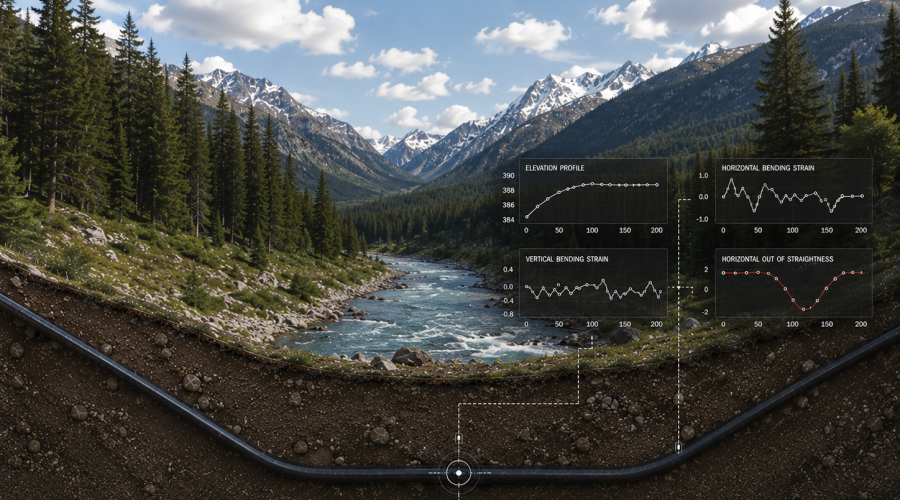
Vendor bending strain reports can identify potential movement and strain-related threats, but without a consistent evaluation framework, determining what actually requires action remains a challenge. This article outlines ILIS’ six-step screening approach for integrating bending strain, integrity threats, and geotechnical information into actionable decision-making.
Bending strain reporting by IMU in-line inspections has seen increased applications in pipeline integrity management. With bending strain being a potential contributing factor to pipeline failures, the overlay of geohazard and pipeline integrity threats at strain areas is of significance.
ILI tools equipped with IMUs allow for accurate 3-D measurements of the pipe displacement of centerline and curvature, which is then used for the calculation of bending strain. Where two or more IMU data sets are available, comparative pipeline movement can also be identified. Yet for many operators, vendor bending strain reports are received without a clear framework to evaluate them, strain events are flagged, but the source is rarely identified, and the path to action is unclear.
This is a gap the industry has not resolved. No standardized guidance exists to align vendor bending strain data with geohazard and integrity threats, determine bending strain sources, or establish the actions required. Without this framework, pipeline integrity and geohazard management programs are left making decisions without a consistent, repeatable basis.
At ILIS, we implemented a consolidated six-step vendor bending strain screening approach to address this gap. The methodology integrates pipeline integrity threats and geotechnical information to identify bending strain sources, assess their cumulative effects on pipeline integrity, and deliver recommendations based on the findings.
Step 1: Bending Strain Criteria and Geohazard Alignment
- ILI vendors report a list of bending strain events, but not all require detailed analysis.
- Known geohazards are aligned with reported bending strain locations, and all intersecting events are included for detailed assessment.
- For remaining events, strain criteria based on pipeline outer diameter and orientation are applied to determine which locations require further screening.
- This step ensures screening effort is focused, and that geohazard-related strain is never overlooked.
Step 2: Pipeline Integrity Data Alignment
- With screening locations established, integrity features are aligned and overlaid at each bending strain area.
- Features include physical crossings, geometry anomalies, metal loss, cracking anomalies, girth welds, and previous dig locations.
- Data is aligned using chainage and girth weld matching, satellite imagery, and GPS coordinate data.
- This overlay builds a complete picture of each location before any source evaluation begins.
Step 3: Evaluation of the Geohazard Overlay
- With data aligned, bending strain events are evaluated against intersecting geohazard information to determine whether observed strain is geohazard-driven.
- Where bending strain source is confirmed to be geohazard-related, the assessment advances to Step 5.
Step 4: Evaluation of Pipeline Surroundings
- For bending strain unrelated to known geohazards, pipeline surroundings are analyzed to infer the possible source.
- Possible bending strain sources are divided into four categories: ILI data processing anomalies, third-party activities, geohazards, and construction or maintenance activities, with geohazard related source being identified in Step 3.
- Construction and excavation activities are considered, and the bending strain source is interpreted using general knowledge on pipeline installation and settlement.
- Where the source cannot be determined from available information, an additional engineering review assessment is required.
Step 5: Integration of Possible Integrity Threats
- Anomalies detected in the pipe are identified as potential contributions to the reduction of strain capacity.
- Metal loss, deformation, and cracking at a high-strain location may represent a compounded threat.
- Correlated with the source findings from Steps 3 and 4, these anomalies provide a more comprehensive understanding of the threat interaction at each bending strain location before any recommendation is made.
Step 6: Determine Future Actions
- With the bending strain source identified and integrity threats evaluated, recommendation is made for each bending strain location.
- Actions are determined based on the likelihood of strain progression, the integrity threats present, and the cumulative risk at each site.
- Recommendations fall into three categories: monitoring at the next ILI interval, further engineering assessment, or immediate follow-up.
Each recommendation is specific, traceable, and tied directly to the findings of the preceding steps.
Why This Approach Matters
This consolidated screening approach uses available data from the pipeline operator's integrity and geohazard management programs to identify possible sources of bending strain and determine future actions to monitor or address threats. By integrating pipeline integrity and geotechnical information into a single, repeatable screening process, operators gain a structured basis for decision-making and the confidence to act when it matters.